
By Matheus Ximenes Pinho, Founder and Managing Director of Vista Furniture Co.
Brazil’s position in the global furniture industry is often reduced to a simple idea: the country has abundant wood. That is true, but it misses the real advantage.
The stronger argument is the combination of material knowledge, regional manufacturing traditions, industrial depth, design culture and an increasingly sophisticated approach to traceability and export compliance. Brazil can produce solid wood dining furniture, case goods, seating, upholstery, panel furniture and design-led collections within the same national ecosystem. Few sourcing markets combine those capabilities at comparable scale.
For international buyers, however, “Brazilian furniture” is not one uniform category. A solid wood factory in northern Santa Catarina operates under a different production logic from an upholstery manufacturer in Paraná, a panel furniture plant in Rio Grande do Sul or an independent design studio in São Paulo or Pernambuco. The country’s value becomes clearer when those differences are understood rather than flattened into a generic country-of-origin story.
This guide explains how Brazil’s solid wood furniture tradition developed, which timber species buyers commonly encounter, what certified wood actually proves, how Brazilian design and upholstery fit into the manufacturing landscape, and what must be verified before a product is ready for export.
Brazil’s furniture tradition is regional, not generic
Brazil’s furniture industry grew through regional clusters. Each cluster accumulated knowledge around specific materials, processes, labor skills and commercial markets.
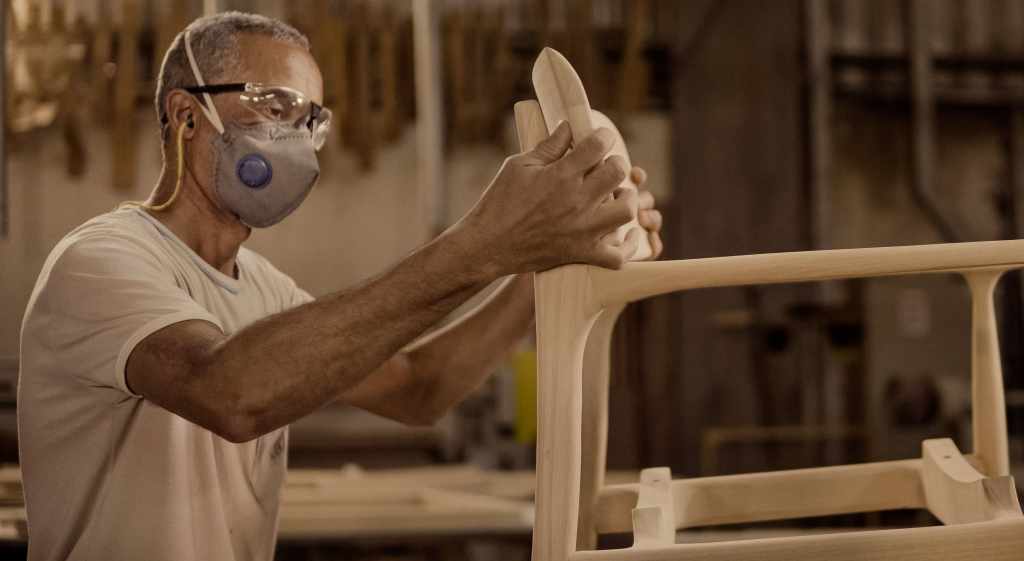
Northern Santa Catarina, especially the region around São Bento do Sul, became closely associated with solid wood furniture, refined finishing and export-oriented residential collections. The region developed experience selling into Europe and North America, where products must survive long logistics cycles and significant changes in temperature and humidity. For buyers evaluating dining tables, beds, chairs, sideboards and case goods in solid timber, this is one of the first regions to investigate.
Rio Grande do Sul developed another manufacturing model. Bento Gonçalves and the Serra Gaúcha contain a dense network of furniture factories, component suppliers, machinery companies, packaging specialists and product-development resources. The region works across panel furniture, kitchens, bedrooms, dining, upholstery, planned furniture and contract applications. Its strength is industrial coordination and the ability to repeat a specification at commercial volume. Movelsul, organized in the region since 1977, has become one of Latin America’s most established furniture business events for retailers, importers and professional buyers. Read Movelsul’s official history and positioning.
Paraná has its own concentration of furniture production, including the Arapongas cluster. The local industry combines panel furniture, mattresses, sofas and other upholstered categories. The regional manufacturers’ association describes Arapongas as Paraná’s largest furniture cluster and one of the country’s largest. The SIMA overview of the Arapongas productive cluster provides useful institutional context.
São Paulo plays a different role. It is less defined by one dominant production material and more by proximity to design studios, architects, premium retail, galleries, specifiers and flexible workshops. The city is important for prototyping, authored collections, hospitality projects, smaller production runs and the commercial interpretation of Brazilian design.
The Northeast adds another layer. Regional designers and makers often work with local craft traditions, fibers, weaving, wood, metal and ceramic techniques. The commercial challenge is not whether the work has value. It is determining which pieces can be reproduced consistently, at what scale and without erasing the technique that made them distinctive. Our field note on sourcing design furniture from Brazil examines that distinction between authorship, technique and reproducibility.
The practical lesson is direct. Brazil should not be sourced as a single interchangeable supplier base. The category determines the region, and the region influences the manufacturing logic.
Why solid wood remains central to Brazilian furniture
Solid wood is not simply a premium material category in Brazil. It is part of the country’s manufacturing vocabulary.
Generations of cabinetmakers, joiners, finishers, upholsterers and industrial engineers have worked with timber as both structure and visible surface. That experience appears in the way a chair frame is dimensioned, how a table accommodates movement, how grain is selected across adjacent parts and how finishing systems are adapted to different species.
The best Brazilian solid wood furniture does not try to hide the material. It uses grain, color variation, edge profile, joinery and proportion as part of the product’s identity.
This matters commercially because solid wood can support several different market positions. Plantation pine can serve accessible dining, bedroom and storage programs. Eucalyptus can support stronger structural components and design-led collections when drying and machining are well controlled. Native hardwoods can create a more distinctive premium offer, provided the origin, species and chain of custody are documented.
Brazil also has a substantial planted-forest base. The Brazilian Forest Service’s national data platform reported approximately 9.9 million hectares of planted forests in 2024. These plantations are largely associated with species such as eucalyptus and pine and support several forest-based industries. See the official planted-forest dashboard.
That scale does not mean every furniture supplier has unrestricted access to every timber species. Material availability varies by region, certification scope, diameter, grade, drying capacity and the commercial relationships between factories and sawmills. Buyers still need to verify the exact supply chain behind the product they intend to order.
Our analysis of solid wood furniture sourcing in Santa Catarina explains why factory discipline, moisture management and export experience often matter more than the beauty of a sample.
The main wood species international buyers encounter in Brazil
Brazilian furniture manufacturers work with both plantation-grown species and native hardwoods. These groups should not be treated as equivalent.
Plantation timber generally offers more predictable supply, broader industrial availability and easier standardization. Native timber can provide distinctive appearance and performance, but it demands stronger documentation and more careful species identification.
The technical properties of Brazilian woods vary widely. Buyers and designers can consult the IPT database of Brazilian and planted woods, which brings together technical information on dozens of species.
Pine
Pine is one of the most widely used plantation timbers in Brazilian furniture.
It is light, relatively easy to machine and suitable for a broad range of finishes. Depending on grade and design, it can be used for beds, dining furniture, shelving, storage, occasional furniture and painted collections.
Its commercial advantages are availability, workability and cost. Its risks are equally clear. Knot distribution, resin, denting, color variation and dimensional stability must be controlled. A buyer should not specify “solid pine” as if that alone defined the product. The grade, lamination method, finger-joint policy, moisture target, visible-face criteria and finishing system all matter.
Pine is especially effective when the design accepts the natural character of the material or when the factory has a disciplined process for selecting cleaner visible components.
Eucalyptus
Eucalyptus is not one single furniture material. It is a broad group of species and hybrids with different density, grain, color and drying behavior.
In furniture, eucalyptus can be used for frames, table components, chairs, beds and other structural applications. It can produce a strong and attractive product, but the result depends heavily on plantation age, sawing pattern, drying schedule and machining.
Fast plantation growth is not the same as easy furniture production. Poorly dried eucalyptus can check, twist or move after assembly. A qualified supplier should be able to explain its species or hybrid, source, kiln schedule, target moisture range and conditioning process.
For buyers, eucalyptus is often most successful when the manufacturer has repeated experience with the exact component type being proposed. A factory that produces eucalyptus chair frames every week presents a different risk profile from one experimenting with the material for the first time.
Tauari
Tauari is widely associated with contemporary Brazilian furniture because of its light color, relatively discreet grain and ability to work across different design languages.
The name “tauari” can refer to more than one species in commercial practice, which is precisely why scientific identification matters. The Brazilian Forest Service’s Wood Products Laboratory describes one studied tauari species, Couratari oblongifolia, as light-colored, with straight grain and medium texture. See the official LPF tauari profile.
Tauari is used in tables, chairs, cabinets and design furniture. Its pale tone works well with natural finishes and makes it commercially adaptable. Buyers should still verify which species is being supplied, whether the factory’s documentation matches the timber in production and whether color variation is acceptable for the collection.
Freijó
Freijó is valued for its warm color and decorative grain. It can appear in solid components, veneers and premium furniture where the surface character is part of the design proposition.
It is often selected for products that need visual richness without the darkness of heavier tropical hardwoods. As with other commercial names, “freijó” should be tied to a verified scientific identity and supply document.
From a sourcing perspective, the main issue is consistency. A beautiful development sample may be produced from a small, carefully selected lot. A repeat order requires the factory to maintain tone, figure and grade across a much larger volume.
Jequitibá
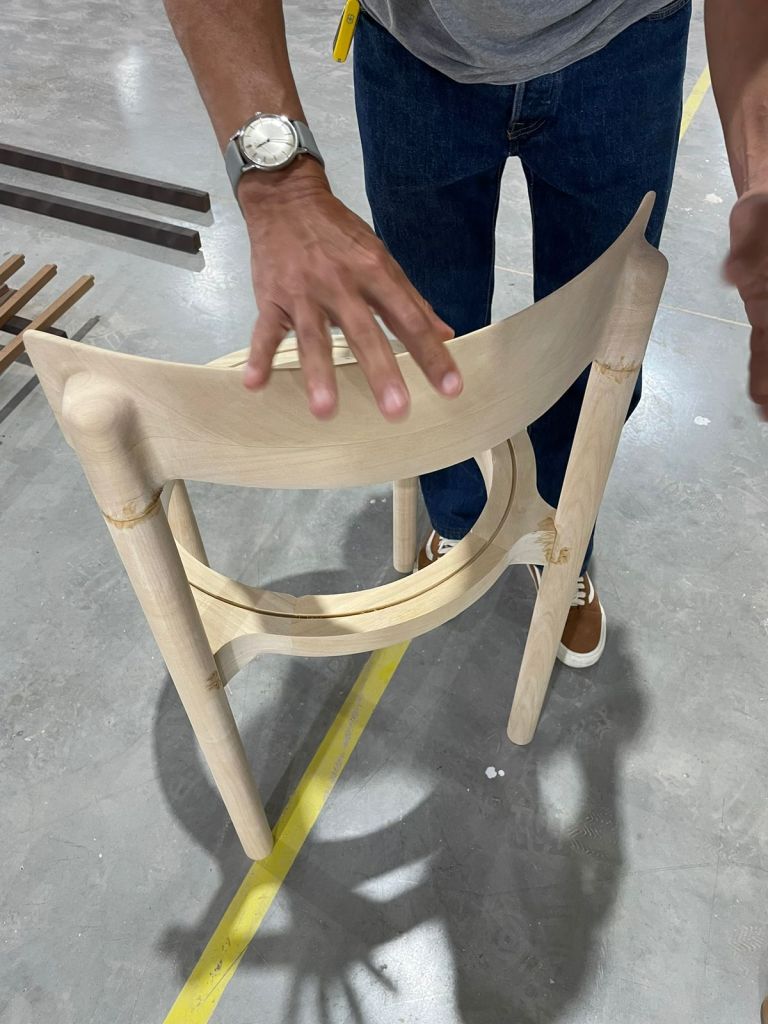
Jequitibá is used in indoor furniture and joinery and can offer a softer, warm appearance suited to contemporary collections.
The commercial name may cover different species. Buyers should avoid treating it as a purely aesthetic label. Density, color, machining and movement can vary. The supplier’s technical sheet should identify the species, source, moisture specification and finish behavior.
Jequitibá can be attractive for dining and living-room programs, but its selection should begin with the engineering requirement, not with a mood board alone.
Cumaru
Cumaru is a dense, heavy hardwood known for high mechanical resistance and durability. It is commonly associated with flooring, decking and outdoor applications, though it can also appear in furniture.
Its density can be an advantage in specific structural or exterior uses. It can also create extra machining, weight, hardware and logistics demands. A heavy timber is not automatically a better furniture timber.
For indoor furniture, cumaru may be appropriate where the design needs its color, strength or surface character. For large tables or export products, the buyer should calculate packaged weight, handling requirements and container economics before approving it.
Jatobá and other dense hardwoods
Jatobá and other dense Brazilian hardwoods can provide strong visual identity and mechanical performance. They can also increase tooling wear, product weight and the difficulty of maintaining color consistency.
These materials are often more effective when used selectively, such as in frames, legs, details or signature pieces, rather than applied indiscriminately across an entire commercial program.
The broader rule is more important than any species list. Specify the performance you need, then evaluate whether the proposed wood can deliver it consistently, legally and at the required volume.
Jacarandá: Brazilian rosewood, historic furniture and the importance of exact identification
Few Brazilian woods carry as much international recognition as jacarandá. The name is closely associated with the country’s most important twentieth-century furniture, particularly pieces produced during the development of Brazilian modern design.
The term, however, requires precision.
In international furniture and antiques markets, “Brazilian rosewood” usually refers to jacarandá-da-bahia, scientifically identified as Dalbergia nigra. This dark, richly figured timber was extensively used in Brazilian furniture, cabinetmaking, musical instruments and decorative interiors during the nineteenth and twentieth centuries.
Its beauty and historic use also contributed to severe pressure on natural populations. Dalbergia nigra is now recognized as a threatened species in Brazil and is listed in Appendix I of CITES, the convention’s highest level of international trade protection.
New furniture made from recently harvested wild jacarandá-da-bahia should therefore not be treated as a normal commercial sourcing category. International commercial trade in wild-sourced Appendix I timber is generally prohibited, except under narrowly defined circumstances and with the required permits.
This does not mean that every piece of jacarandá furniture is illegal.
A significant market exists for historic Brazilian furniture made before the current restrictions. Original pieces by twentieth-century designers, as well as anonymous period furniture, may contain jacarandá harvested and manufactured decades ago. Their sale and international movement may still require documentation demonstrating age, legal origin and, where applicable, pre-Convention status.
New pieces can also appear when a designer or manufacturer has access to a legally documented pre-existing stock, reclaimed timber, recovered material or wood from another species commercially known as jacarandá. The documentation must identify the precise species and explain the legal basis for its use.
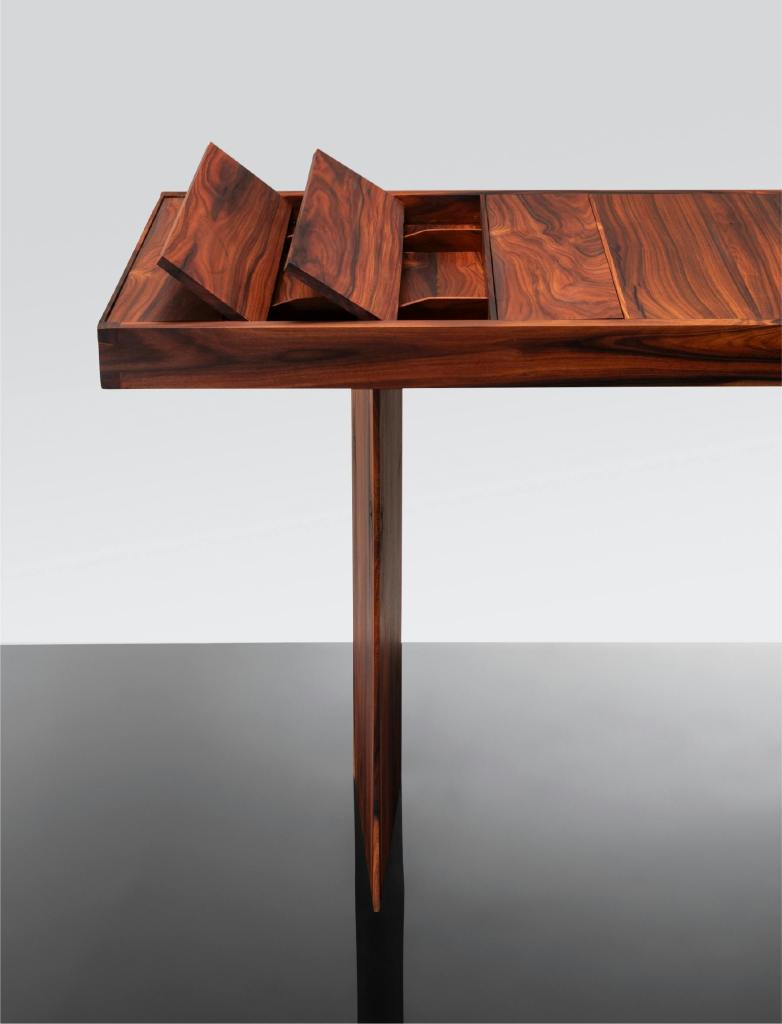
That distinction is visible in the work of Brazilian designer Vinicius Siega. His Tríptico collection, presented during SP-Arte 2026, was developed from a limited and certified lot of solid jacarandá-caviúna, identified by the designer as Machaerium scleroxylon. The material was used in pieces including the Master Desk, showing how a rare and historically significant timber can become part of a contemporary collection when its identity, quantity and origin are documented.
See Vinicius Siega’s Tríptico collection and the Master Desk.
International buyers should not use “jacarandá” as a complete material specification. Jacarandá-da-bahia, jacarandá-caviúna and other woods sold under related commercial names are not interchangeable. They may belong to different botanical genera, carry different conservation classifications and require different trade documentation.
For any furniture described as jacarandá, the buyer should request:
- The scientific name of the species
- Proof of legal origin
- The date and source of acquisition
- Applicable forest and transport documents
- Certification or chain-of-custody records
- CITES permits when required
- Confirmation that the available volume can support the proposed production run
- Documentation that can accompany the furniture into the destination market
Jacarandá remains central to the history of Brazilian furniture. Today, its legitimate use depends less on the prestige of the name and more on the strength of the documentation behind the wood.
Common names are not enough
International buyers should insist on scientific names in timber documentation.
A commercial name can refer to multiple botanical species. The same species can also be sold under different common names in different regions. This creates risk for purchasing, customs declarations, sustainability claims and product consistency.
For imports into the United States, the Lacey Act declaration framework can require plant information that includes genus and species for covered products. The USDA Animal and Plant Health Inspection Service provides the current declaration guidance and implementation information. Review the official Lacey Act declaration page.
A quotation that says only “Brazilian hardwood” is not adequate for a serious sourcing program. The buyer should know what the material is, where it came from, which documents accompany it and whether the factory can maintain the same specification for repeat production.
Legal wood and certified wood are not the same claim
This distinction is essential.
Legal-origin documentation demonstrates that timber moved through the required regulatory system. Certification introduces an additional standard and chain-of-custody framework. One does not automatically replace the other.
For native Brazilian timber subject to federal control, the Documento de Origem Florestal, or DOF, is a key part of the transport and storage control system. IBAMA’s DOF+ framework was created to improve the management and traceability of licenses for native forest products. Read the official DOF+ information.
FSC certification addresses another layer. Forest management certification evaluates management against environmental, social and economic criteria. Chain of Custody certification tracks certified material through processing and commercial stages.
Brazil had almost 9.86 million hectares certified under FSC as of January 2026, alongside more than 1,300 Chain of Custody certificates, according to FSC Brazil. See FSC Brazil’s current facts and figures.
A buyer should not stop at seeing an FSC logo in a presentation. The certificate must be active. The company named on the purchase documents must match the certificate structure. The product group and material claim must fall within the certificate scope. FSC Brazil directs buyers to the official certificate database for this verification. Search the FSC certificate database.
A factory may hold Chain of Custody certification and still be unable to sell a particular item with an FSC claim if the timber, supplier or product scope is not covered. Certification must be read at product level.
What a credible timber file should contain
For a commercial solid wood program, the buyer should expect a documentation file that connects the finished product back to the material supply chain.
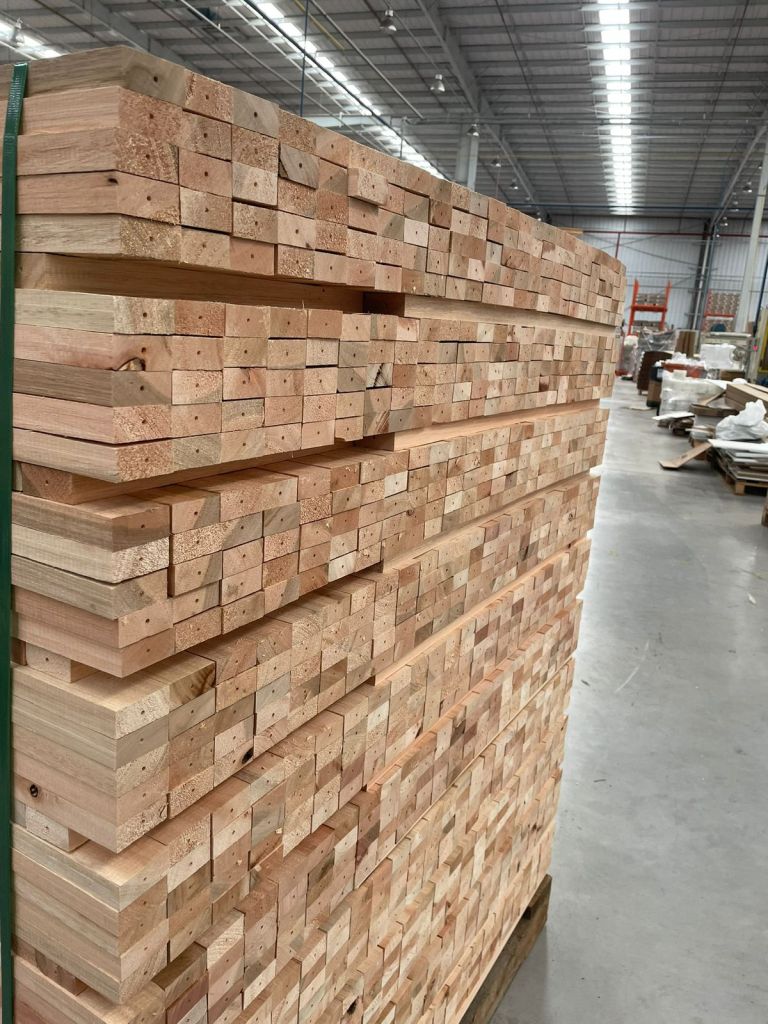
That file may include purchase records, invoices, species identification, supplier information, applicable DOF documentation, FSC certificate codes and claims, production records, batch references and export documents.
The exact file changes according to the species, product, destination and certification claim. The principle does not.
The paper trail must connect to the physical product.
A certificate held by a company is not proof that the timber currently on the factory floor belongs to the certified supply chain. During factory qualification, buyers should compare documentation with inventory, labels, production orders and supplier records.
Our supplier audit checklist for Brazilian furniture manufacturers covers the broader operational controls that should be reviewed before a purchase commitment.
Moisture content is where solid wood programs succeed or fail
A well-designed table can fail because of moisture. A beautiful chair can crack because components were assembled before they reached the right equilibrium. A cabinet door can move after arrival because the product traveled from a humid manufacturing environment into a dry, heated interior.
Wood remains hygroscopic after production. It exchanges moisture with the surrounding air. The goal is not to make wood permanently inert. It is to dry, condition, engineer and finish it for the environment it will enter.
A supplier qualification should examine kiln capacity, drying schedules, calibrated moisture meters, measurement frequency, storage conditions, component thickness, glue curing, lamination, joinery and final inspection.
The destination matters. A product shipped from southern Brazil to Florida faces a different use environment from the same product shipped to Colorado, Toronto or northern Europe.
The moisture specification should therefore be connected to the destination market and product construction. A single number copied into a purchase order is not a moisture-control system.
This is also why factory experience matters. A manufacturer with years of repeat exports to a dry climate has operational knowledge that may not appear on its machinery list. The records, rejected batches and corrective actions often reveal more than the showroom.
Brazilian design turns material knowledge into commercial identity
Brazil’s furniture tradition is not only industrial. It is also intellectual and cultural.
Modern Brazilian furniture developed a recognizable language through the relationship between architecture, body, climate, local materials and informal ways of living. Wood and leather were not added as decorative signals of “Brazil.” They were often central to structure, posture and use.
Lina Bo Bardi’s early furniture work explored simplicity, national materials and references to Brazilian culture. Instituto Bardi documents the role of Studio de Arte Palma and pieces created for the Glass House, including the Bardi’s Bowl chair. Explore the Instituto Bardi exhibition on Lina’s early furniture.
Sergio Rodrigues brought timber, leather, generous proportions and a distinctly Brazilian sense of comfort into international design history. His work is represented in the Museum of Modern Art’s design context. See MoMA’s Sergio Rodrigues profile.
Paulo Mendes da Rocha’s Paulistano Chair showed another path, using a continuous steel structure and a suspended cover to create a direct relationship between engineering and comfort. View the Paulistano Chair in MoMA’s collection.
The Campana brothers later demonstrated how Brazilian material culture, improvisation and hand processes could enter the global collectible-design conversation. MoMA describes the Vermelha Chair as a work inspired by Brazilian weaving traditions, with cord hand-woven into the seat. View the Vermelha Chair.
These examples matter to commercial buyers because Brazilian design can create differentiation that is difficult to reproduce through styling alone. The strongest pieces emerge from a real understanding of material and construction.
They also introduce a responsibility. Authored design is not an open catalog of forms to copy. Buyers must verify licensing, ownership, territorial rights, exclusivity and the factory’s authority to manufacture a piece. A product inspired by Brazilian modernism is different from an unauthorized reproduction of a protected design.
Design value must survive industrial repetition
A prototype can be exceptional and still be unsuitable for a retail program.
The sourcing question is whether the material, construction and finish can survive repetition. That means evaluating jigs, templates, CNC files, upholstery patterns, color standards, approved samples, tolerance limits and inspection criteria.
For design-led solid wood furniture, grain selection is part of repeatability. One sample may use unusually calm boards. Commercial production must define what happens when knots, sapwood, mineral streaks or color variation appear.
The same applies to hand-shaped edges and carved components. The buyer must decide how much variation expresses authorship and how much becomes a quality defect.
This is where Brazil’s mix of industrial and craft knowledge becomes useful. Some factories can translate an architect’s concept into a repeatable system without removing its character. Others are better suited to limited runs. The correct answer depends on the channel.
Upholstery is a major part of Brazil’s manufacturing tradition
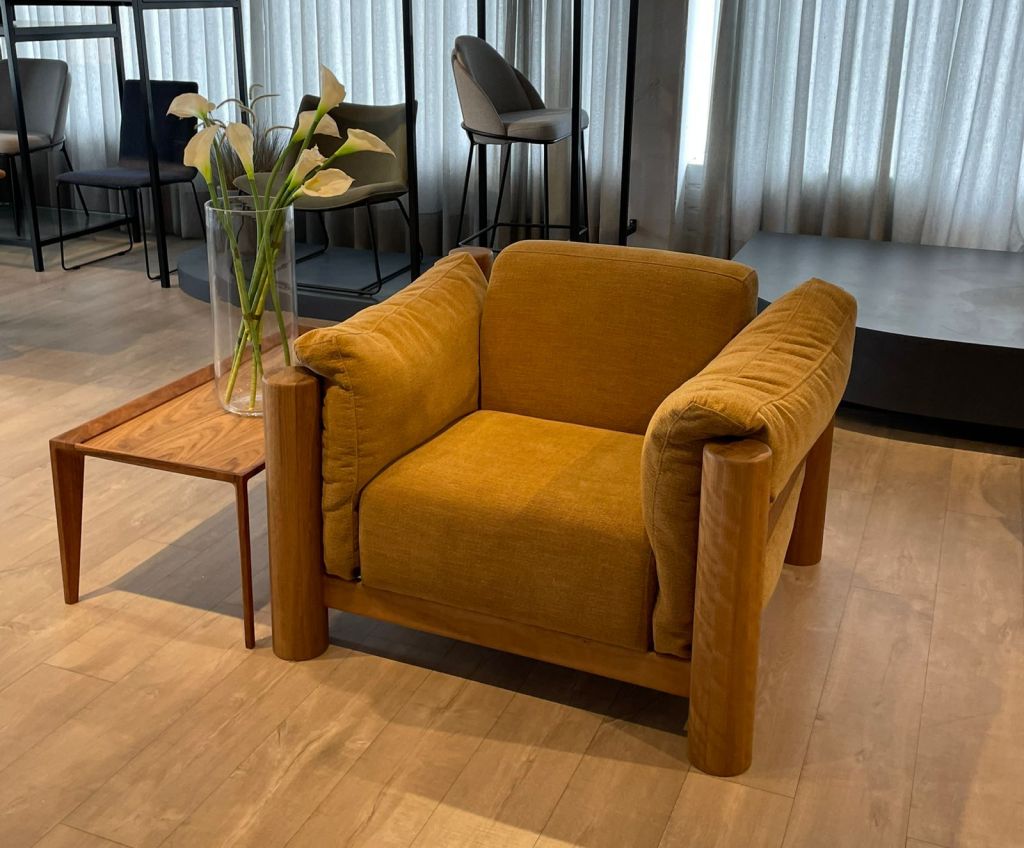
Solid wood receives much of the international attention, but upholstery is equally important to understanding Brazilian furniture.
Brazilian manufacturers produce sofas, sectionals, lounge chairs, dining chairs, ottomans, benches, upholstered beds and mattresses across several market levels. Strong upholstery capabilities exist in Rio Grande do Sul, Paraná, Santa Catarina and other regional clusters.
ABIMÓVEL’s 2025 sector data reported total furniture and mattress exports of US$769.3 million. The same dataset identifies wood furniture as the largest product segment and records growth in upholstered furniture exports. The United States represented the largest destination share. Consult ABIMÓVEL’s current sector data and the Brazilian government’s Comex Stat platform for official trade queries.
Brazilian upholstery benefits from an established culture of comfort, generous proportions and mixed-material construction. Many products combine solid wood or plywood frames with foam, webbing, springs, fabric, leather and metal mechanisms.
The visible cover is only one layer. A professional audit should evaluate frame species, moisture, joint construction, suspension system, foam specification, adhesive, sewing, seam allowance, pattern matching, fabric-lot control, cushion recovery and dimensional consistency.
For e-commerce, packaging becomes part of product engineering. Sofas and lounge chairs must survive compression, container movement, warehouse handling and final-mile delivery without crushed corners, deformed cushions or fabric abrasion.
Destination-market rules also matter. California’s Technical Bulletin 117-2013 sets smolder-resistance test methods for materials used in upholstered furniture sold in the state. Read the official TB117-2013 document.
The correct factory is therefore not merely one that can build a comfortable sofa. It must control hidden construction, material documentation, testing, labeling and packaging for the intended market.
Export readiness begins before the purchase order
Brazil exported US$769.3 million in furniture and mattresses in 2025, according to ABIMÓVEL. The figure confirms an established international business base, but national export experience does not mean every factory is ready for every buyer.
Export readiness is product-specific and market-specific.
A factory may export solid pine furniture to South America and still lack the systems required for a large U.S. e-commerce program. Another may have strong European experience but limited capacity for parcel-tested packaging. An upholstery producer may build excellent domestic sofas without the test reports or law-label process required by the destination.
For the United States, wood products may fall within Lacey Act declaration requirements. Composite wood components can trigger TSCA Title VI formaldehyde-emission requirements. The U.S. Environmental Protection Agency states that the rule covers hardwood plywood, MDF and particleboard, as well as finished goods containing regulated composite wood products. Review the official EPA guidance.
This distinction matters for “solid wood” furniture. A product may have solid wood legs and rails but use plywood, MDF or particleboard in backs, drawers, panels or hidden structural parts. The compliance review must examine the complete bill of materials.
For the European Union, the EUDR framework covers wood and certain derived products and places due-diligence obligations on operators and traders. Implementation timetables have changed, so buyers should review the current official guidance rather than rely on an old presentation or supplier summary. See the European Commission’s EUDR overview.
Export preparation also includes carton specifications, pallet or crate decisions, assembly instructions, hardware bags, spare parts, barcodes, importer information, country-of-origin marking, container loading and pre-shipment inspection.
A product is not export-ready because the factory has issued an invoice in dollars. It is export-ready when the product, documentation, packaging and production controls have been aligned with the destination and channel.
Our guide to identifying export-ready manufacturers at Movelsul explains why trade-show presentation and operational readiness are different claims.
What international buyers should verify inside the factory
A strong solid wood or upholstery supplier should be able to show how the product is controlled, not simply describe it.
Start with the material. Confirm species, scientific name, supplier, grade, certification claim and applicable origin documents. Inspect how timber is identified in storage and how it is connected to production orders.
Then inspect moisture management. Review the kiln process, measurement records, equipment calibration, storage after drying and component readings during production.
Follow the product through machining and assembly. Look at jigs, tolerances, rejected components, glue application, sanding sequence, finish preparation and curing time.
For upholstery, inspect the frame before it disappears under foam and fabric. Review suspension, foam identification, cutting patterns, seam construction and material-lot traceability.
Ask how the approved sample is protected. A golden sample should be identified, stored correctly and connected to a current specification. Photographs alone are not enough.
Review quality control independence. A final inspector who reports only to the production manager may face pressure to release a late order. The buyer should understand who can stop production and how corrective action is recorded.
Inspect packaging as a system. The carton, internal protection, hardware, manual and loading plan must match the product and distribution channel.
Finally, test communication. Ask for a production status report, a material record or a corrective-action example. The speed, precision and completeness of the response reveal how the relationship will function after the order is placed.
Brazil’s advantage is not one species or one style
Brazil is relevant to international furniture buyers because it offers several manufacturing propositions within one country.
It has plantation timber for scalable programs. It has native hardwoods with distinctive visual character. It has industrial clusters capable of repeat production. It has workshops and studios that preserve authorship and local technique. It has an established upholstery base. It has designers whose work has entered major international museum collections. It has a regulatory structure for forest-product control and a large FSC-certified area.
None of those strengths removes the need for qualification.
The same diversity that creates opportunity also creates complexity. Species names can be ambiguous. Certification claims can be misunderstood. A factory’s domestic success can hide export gaps. A compelling design can fail under repeated production. A technically sound product can arrive damaged because the packaging was treated as an afterthought.
The correct sourcing process connects the material, factory, design, destination and commercial model before the purchase order is released.
International buyers exploring Brazil can begin with our analysis of why global furniture companies are reconsidering Brazil and our guide to finding reliable Brazilian furniture manufacturers.
Vista Furniture Co. works buyer-side to qualify Brazilian manufacturers, assess production capability, review export readiness, support product development and document the risks behind a sourcing decision.
Talk to Vista Furniture Co. about your furniture category.
About the author
Matheus Ximenes Pinho is the Founder and Managing Director of Vista Furniture Co. He has more than twenty years of experience across home and décor, architecture, product development, furniture, retail, e-commerce and marketplaces. Based in São Paulo, he advises international buyers evaluating Brazilian manufacturers, materials, design capabilities and export readiness.
 Brazilian Furniture Sourcing Hub
Leave a comment