
By Matheus Ximenes | Vista Furniture founder | Published on June 26, 2026 • 6 min read
Walking through the exhibition pavilions at Movelsul Brasil 2026 (August 17–20) offers global furniture buyers an impressive display of contemporary design, high-end materials, and competitive container pricing. The southern Brazilian manufacturing clusters are packed with industrial capacity.

However, for international enterprise retailers, category managers, and e-commerce platforms, there is a massive operational chasm between a product looking beautiful on a trade show floor and that same product being structurally prepared to survive an ocean crossing, multi-tiered warehouse handling, and strict customs regulations.
True Export Readiness is not about aesthetic appeal; it is a rigorous set of engineering, quality management, and legal parameters. Contracting a supplier who lacks these protocols often results in high last-mile damage rates, customer returns, or entire shipping containers being impounded at international borders.
As your independent local sourcing partner, Vista Furniture Co. bridges this technical gap. While our team is on the ground at Movelsul 2026 providing direct trilingual support, we utilize this specific technical blueprint to audit factory operations from the exhibition booth straight to the factory floor.
If you are vetting Brazilian furniture manufacturers independently, here is the technical checklist you must use to evaluate their operational maturity.
1. Quality Management Systems (QMS) on the Production Line
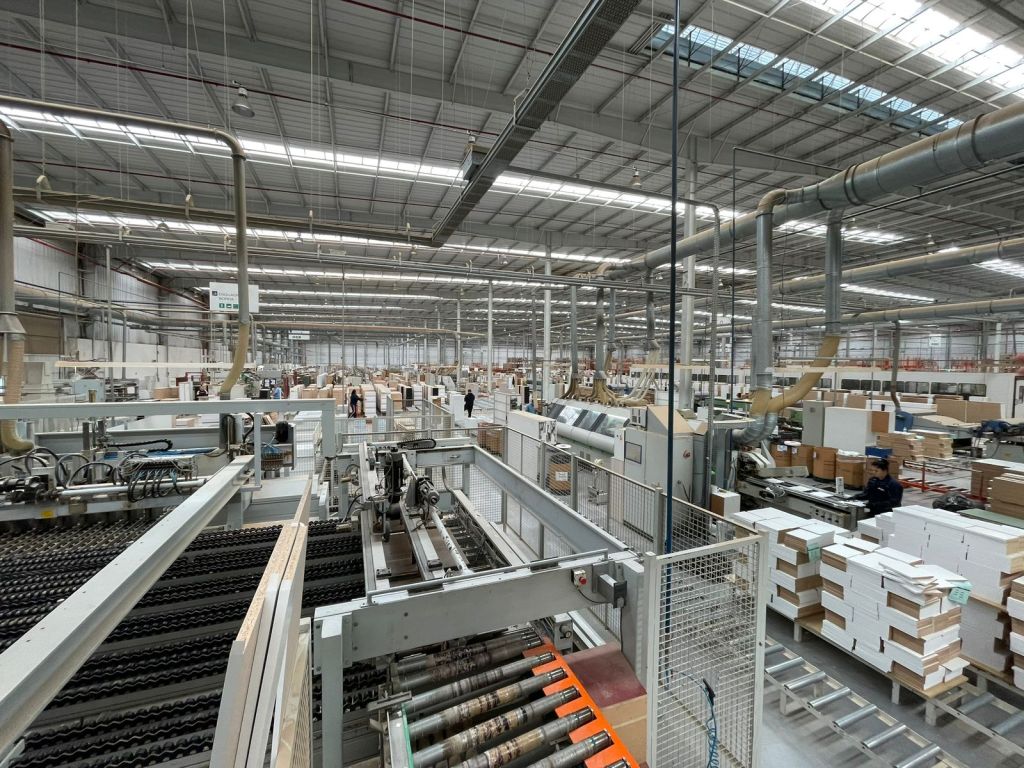
A factory’s capacity to deliver consistent quality across a 50-container contract relies entirely on their Quality Management Systems (QMS). When auditing a manufacturer, look for independent Quality Control (QC) teams that report directly to executive management, completely detached from production speed pressures.
Your technical inspection must evaluate three distinct checkpoints:
- IQC (Incoming Quality Control): How does the factory audit raw lumber, MDF/MDP panels, and hardware before production begins? For solid wood products (like Brazilian pine or eucalyptus), the wood’s moisture content must be rigidly controlled between 8% and 12%. If a factory uses wood with higher moisture retention, the components will warp, split, or crack when exposed to drier climates in North America or parts of Europe.
- IPQC (In-Process Quality Control): Are dimensional accuracy checks automated? High-maturity factories utilize automated CNC machining protocols where tolerances are checked to fractions of a millimeter after routing and before finishing coats are applied.
- OQC (Outgoing Quality Control): Does the factory conduct pre-shipment assembly audits? A percentage of every manufactured batch must be fully assembled manually to guarantee hardware alignment, screw hole threading, and the absolute clarity of instruction manuals.
2. Packaging Engineering for E-Commerce and Last-Mile Delivery
For modern digital marketplaces and multi-channel retailers, last-mile transit damage is the single greatest drain on profitability. Standard domestic packaging setups (low-density foam and thin single-wall cardboard) are completely insufficient for international distribution networks.
┌────────────────────────────────────────────────────────┐│ ISTA PACKAGING COMPLIANCE MATRIX │├───────────────────────────┬────────────────────────────┤│ ✔️ High-Density Edge Foam │ ✔️ Reinforced Corner Guards ││ ✔️ Drop & Vibration Tested │ ✔️ Double-Wall Five-Ply Box│└───────────────────────────┴────────────────────────────┘
When evaluating a manufacturer’s RTA (Ready-To-Assemble) casegoods or flat-packed items at Movelsul, ask deep questions about their packaging specifications:
- ISTA Standards Certification: Can the factory provide certified data for ISTA 3A or ISTA 6 packaging drop tests? These protocols simulate the exact vertical drops, vibration, and compression a box experiences inside transit networks like FedEx, UPS, or Amazon fulfillment centers.
- Structural Interlining: True export packaging requires high-density expanded polystyrene (EPS) edge protectors, heavy-duty corner guards, and scratch-resistant foam sheets separating finished panels. If a factory cannot adapt their packaging lines to your specific ISTA guidelines, your damage rate will spike.
3. Navigating International Regulatory Compliance
Entering international markets without rock-solid product compliance documentation is a massive risk. Your sourcing strategy must verify that the manufacturer understands and complies with your target country’s legal landscape.
┌───────────────────────────┬────────────────────────────┐│ NORTH AMERICAN CODES │ EUROPEAN CODES │├───────────────────────────┼────────────────────────────┤│ • California TB117-2013 │ • BS5852 Flammability ││ • TSCA Title VI Formald. │ • GPSR Compliance ││ • US Law Labels │ • UKCA / CE Marking │└───────────────────────────┴────────────────────────────┘
Market Track A: North America (US & Canada)
- TSCA Title VI / CARB Phase 2: If you are buying furniture made from engineered wood (MDF, MDP, plywood, particleboard), the factory must prove compliance with formaldehyde emission standards. Ask to see their independent third-party certifications (TPC). Every shipping carton must carry compliant tracking labels.
- Flammability Requirements (California TB117-2013): For upholstered items (sofas, accent chairs, bedding), the foam and textile materials must pass strict smolder resistance tests. The manufacturer must supply certified flame-retardant raw materials and sew permanent US Law Labels directly into the product seams.
Market Track B: United Kingdom & Europe
- BS5852 Compliance: The UK market demands specialized fire safety compliance for upholstery, requiring distinct textile back-coatings and foam formulations compared to mainland Europe.
- GPSR (General Product Safety Regulation): For the EU market, casegoods must have fully documented technical files, continuous manufacturer traceability markings, and clear safety declarations mapped out before customs entry.
De-Risking Your Sourcing Strategy with Vista Furniture Co.
Vetting these technical parameters at a trade show booth is incredibly difficult. Most sales representatives at the pavilions are trained to close orders, not to discuss the chemical specs of polyurethane foam or the drop-test data of a cardboard carton box.
That is why Vista Furniture Co. acts strictly as your independent local advisory partner on the ground.
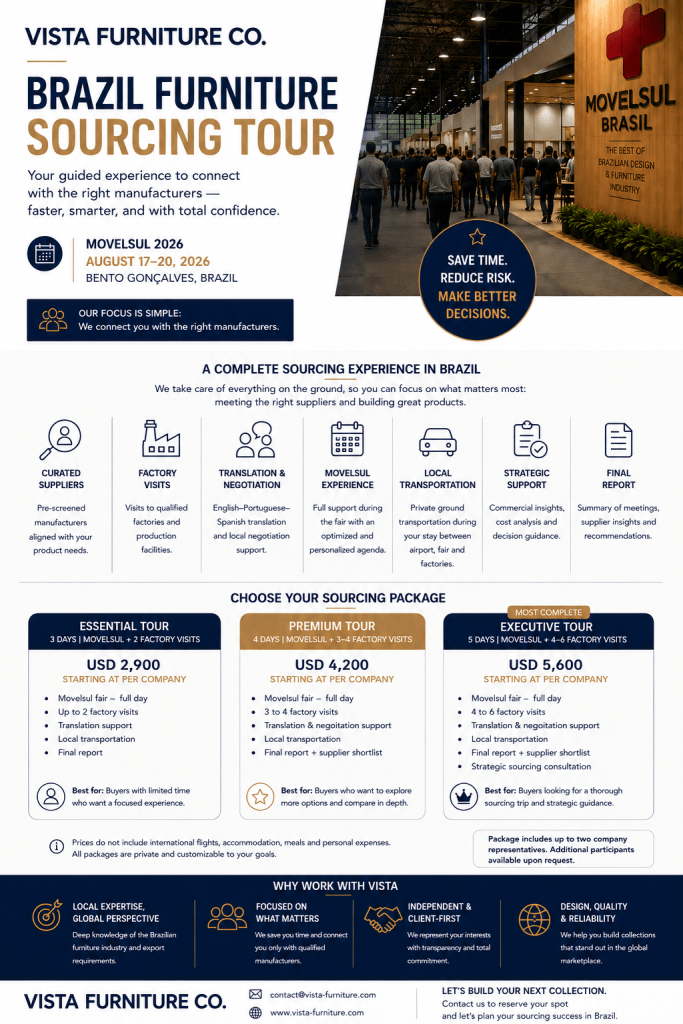
Through our Executive Sourcing Tour, we don’t just walk the show floor with you. When we identify a potential supplier at Movelsul, we immediately schedule an on-site audit. We take you inside their production facilities to physically inspect their lumber drying kilns, audit their incoming quality control logs, and test their packaging lines firsthand.
We look past the showroom aesthetics to ensure your product portfolio is built on a stable, legally compliant, and industrially repeatable foundation.
Secure Your Private Sourcing Tour for Movelsul 2026
Ensure your transition into the Brazilian market is backed by deep material expertise, localized logistics, and uncompromised quality control. Vista’s available tour slots are strictly limited to maintain hands-on consultant support from our executive directors.
- 📧 Contact Our Advisory Team: contact@vista-furniture.com
- 🌐 Explore Our Full Sourcing Matrix: https://brazilfurniture.com/2026/06/25/brazilfurniture-com-movelsul-2026-sourcing-guide/
- 💬 Connect Instantly via WhatsApp: +55 11919000606
- Instagram: @vista.furniture.co
- Linkedin: Vista Furniture Co.

 Brazilian Furniture Sourcing Hub
Deixe um comentário