
By Vista Furniture Co. | July 12th, 2026
Not every buyer sourcing from Brazil is building a volume program. A significant number are building curated assortments: fewer references, higher margin, authorship as part of the product rather than a decoration applied to it.
For that buyer, most of what is written about furniture sourcing is close to useless, because it was written for the volume case. The questions that govern a panel furniture program, covered in Sourcing RTA and panel furniture from Brazil, are not the questions that govern a design assortment. Applying them produces a competent, unremarkable catalogue. Ignoring them entirely produces a beautiful catalogue that cannot be delivered.
An exhibition in Recife made the actual question unusually easy to see, because it put both answers in the same room.
One room, twenty-five designers
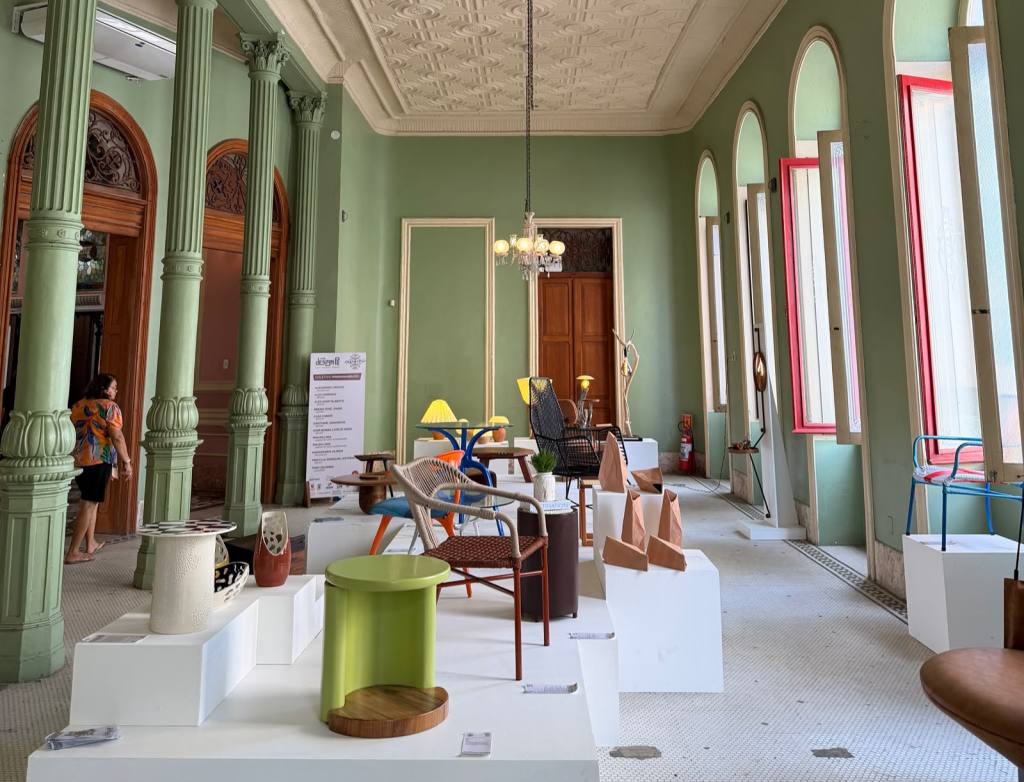
Design PE, Entre Matéria e Memória, was held at the Palácio do Comércio in Recife, capital of the northeastern state of Pernambuco. Curated by Jaildo Lima and organised by the Coletivo Paranambuco, it brought together 25 designers from the state and more than 70 pieces across a range of typologies.
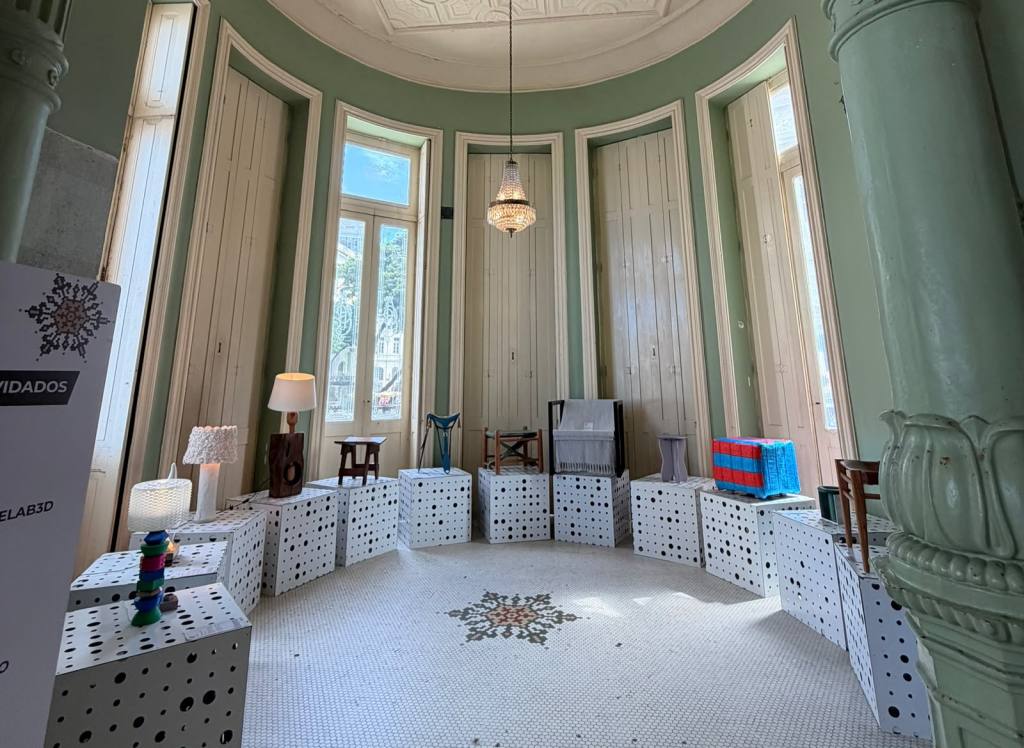
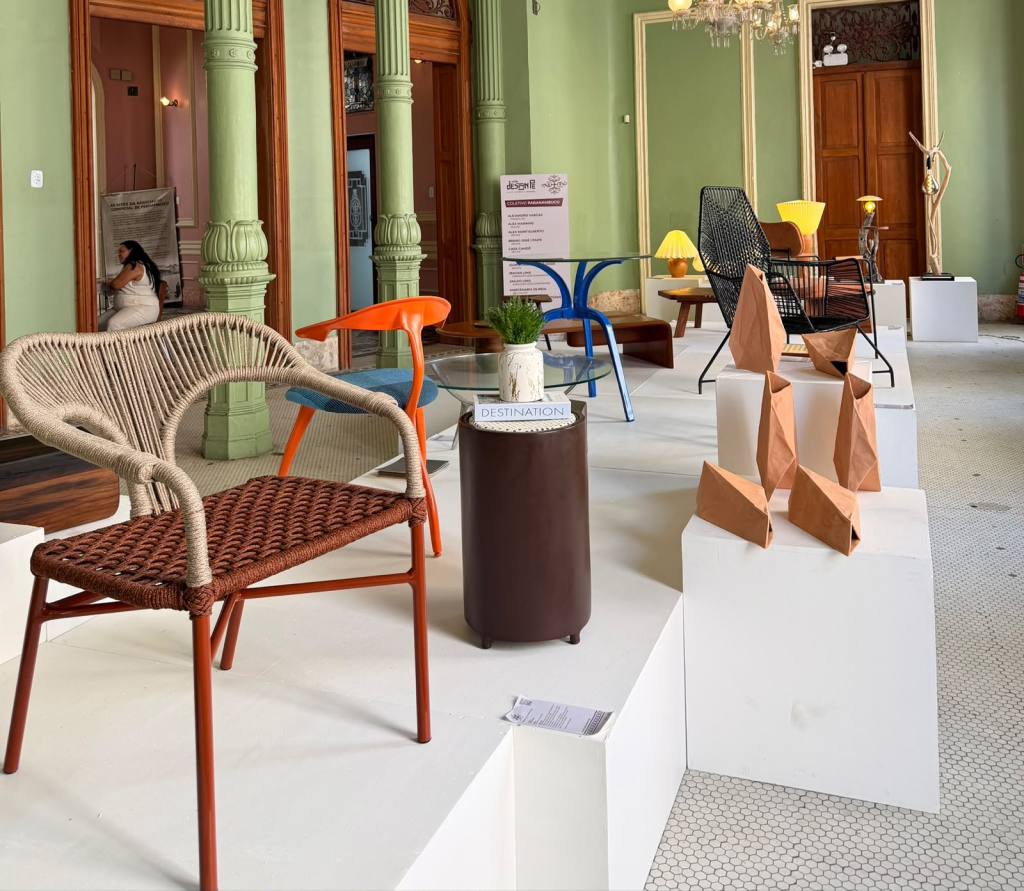
Industrially produced chairs and tables shared the floor with seats woven on a hand loom, one of them fixed using the knots employed in a Brazilian hammock. Ceramic objects sat near lamps made from recovered PET. Solid wood shared the space with metal. Pieces by designers of different generations, at very different production scales, were displayed on identical plinths, in identical light, with identical labels.
Seen from the outside, that mix reads as cultural range, and it is precisely that. Seen from a buyer’s chair, it reads as something more immediately useful, and slightly uncomfortable: a spectrum of reproducibility, laid out in a single room, with no indication of where any given piece sits on it.
That absence of indication is the entire problem. In an exhibition, presenting every piece as equal is curatorially correct. In a sourcing decision, it is the thing that costs money.
Where the design is anchored
It is tempting, and wrong, to describe this as a contrast between an industrial south and an artisanal northeast. That framing flatters nobody and misdescribes both.
Pernambuco is not an alternative to the industrial clusters of the south, and the south is not short of design. Santa Catarina has supplied design-led brands for decades. Rio Grande do Sul has a substantial design and engineering base embedded in its industry. The difference is not the quantity of design present. It is where the design is anchored.
In Santa Catarina and Rio Grande do Sul, design largely lives inside an industrial system. It is conceived, from the first sketch, to be produced in series. It is judged by how well it survives repetition, and the discipline that surrounds it is manufacturing discipline. A design that cannot be produced consistently at volume is, in that system, simply a failed design.
In Pernambuco, a substantial share of the work is anchored in local technique and local material. The value is not principally in how well it repeats. It is in what it carries: a method, a material, a place, a hand. A piece that can only be made by a small number of people, slowly, is not a failed design in that system. It may be the point.
Both are legitimate. They answer different questions. Confusing them is one of the more expensive mistakes available to a buyer, and it is almost always made in the same direction: falling for an object made under one logic, and ordering it under the other.
The question the object cannot answer
Stand in front of a hand-woven seat. It is beautiful, it is distinctive, it is unmistakably from somewhere. It photographs extremely well, which in a curated retail context is not a trivial property.
Now ask the only question that matters commercially: what happens if I order three hundred?
There are three honest answers, and the buyer’s job is to know which one applies before the object is committed to a catalogue.
It scales as it is. Some techniques that appear artisanal are in fact well-organised small-batch production with real, expandable capacity behind them. The piece looks handmade because it is, and because there is a workshop with fifteen people who do exactly this. Three hundred is a scheduling conversation, not a redesign.
It scales, but it becomes a different object. This is the most common and the most dangerous case. Meeting the volume requires mechanising the weave, substituting the material, or replacing the maker with a process. The result resembles the original. It photographs almost as well. And it no longer contains the thing that made it worth buying, which the customer will not be able to articulate but will register as a lower willingness to pay.
It does not scale, and should not. The capacity ceiling is real, and pushing through it destroys either the piece or the maker, frequently both. This is not a failure of the supplier. It is a characteristic of the object, and the correct commercial response is to treat it as a limited reference rather than to force it into a program that will break it.
An industrially produced piece from the same room can hold a program without changing character, because its character was never located in the irreproducible part. This does not make it a better piece. It makes it a different instrument.
Authorship is an asset. Reproducibility is a decision.
For international buyers building curated assortments, Brazilian authorship is meaningfully underexploited. The country has a deep design tradition, a distinctive material vocabulary, and, in regions like Pernambuco, techniques with genuine provenance rather than applied styling.
What is missing, from the buyer’s side, is a reliable way to read it. And the reading is not primarily aesthetic. It is structural.
The useful questions are about the technique rather than the object. What is the technique, actually, once described precisely rather than romantically? Does it survive a production run at all, and if so, at what run length does it begin to change? Where is the maker capacity, in people rather than in intentions, and what is its real ceiling? What breaks first when volume doubles: the schedule, the consistency, or the piece itself?
And, finally, the question that separates a serious buyer from a tourist: if the piece has to change in order to scale, is it still worth its price once it has changed?
This is not romantic. It is operational. It tells you what you can order, at what volume, and what you would destroy by trying.
Small scale does not mean exempt
There is a persistent and expensive assumption that authorship-led, small-run sourcing sits outside the regulatory frame that governs volume imports. It does not, and the workshops producing this work are frequently the least equipped to demonstrate compliance, precisely because they have never had to.
Furniture imported into the United States is subject to Lacey Act declaration requirements, which since Phase VII implementation in December 2024 cover a broad range of furniture. The declaration requires the scientific name, being genus and species, and the country of harvest for each plant species in the product. A workshop that identifies its timber by a regional common name cannot supply that, and the obligation to supply it sits with the importer of record, not with the workshop.
Where composite panels are present in a piece, the EPA’s TSCA Title VI formaldehyde standards apply to the finished good as well as to the panel, with certification, labelling and recordkeeping consequences for the importer.
Neither of these is a reason to avoid small-scale Brazilian producers. They are a reason to understand, before committing, what a given producer can and cannot document, and to know who is going to close that gap. In curated sourcing, that gap is frequently the buyer’s to close, and it should be priced accordingly rather than discovered at the port.
What buyers get wrong in curated sourcing
They evaluate the object and not the capacity behind it. The object is on a plinth. The capacity is four hundred kilometres away, and is the thing that will actually determine whether the program exists.
They assume that small means flexible. Small frequently means fully committed, with no headroom, and a single point of failure who is also the owner, the designer and the person who does the finishing.
They negotiate price before understanding the run. In this category, price is downstream of run length, and asking for a lower price without changing the run is asking the maker to absorb the difference, which they will do once.
They discover compliance late. See above. It is the most avoidable failure on this list.
They treat authorship as decoration. If the story is the product, then losing the story to scale means losing the product while keeping the cost.
A note on curation as a sourcing model
There is a category of buyer, still relatively small internationally, whose entire proposition rests on selection rather than on volume: galleries, design-led retailers, hospitality specifiers, and marketplaces built around named designers rather than around price points.
For that buyer, sourcing is not a procurement function. It is an editorial one. The assortment is the product, and the supplier list is the manuscript.
This changes the economics of sourcing intelligence in a way that is worth stating plainly. A volume buyer needs to be right about a small number of suppliers, because each supplier carries an enormous amount of value. A curated buyer needs to be right about a much larger number of much smaller relationships, each of which carries less revenue and, individually, less risk, but which collectively determine whether the assortment holds together and whether it can actually be delivered on the dates promised.
The failure mode is correspondingly different. Volume sourcing fails loudly, in a container. Curated sourcing fails quietly, one reference at a time: a piece that cannot be reordered, a maker who has stopped, a lead time that has doubled without notice, a technique that has been substituted without anyone being told. The assortment erodes rather than collapses, and by the time it is visible in the numbers, it has been happening for two seasons.
Reading a small producer is therefore a different discipline from reading a factory. It has less to do with systems and more to do with dependency: who actually makes the piece, what happens if that person is unavailable, whether the workshop has ever produced at the volume being discussed, and whether the price being quoted reflects the run being requested or the run they are used to.
The map, and why it matters
Taken together, the three regions form something like a map, and the map is the point.
Santa Catarina answers a question about durability and climate, and the discipline that answers it is drying. Rio Grande do Sul answers a question about volume and consistency, and the discipline that answers it is repeatability. Pernambuco, and the northeast more broadly, answers a question about authorship and technique, and the discipline that answers it is knowing the limits of what a technique will bear.
A buyer who understands the map does not ask “can I source furniture in Brazil.” They ask a narrower and far more productive question: which part of Brazil answers the question I actually have, and what will it cost me to ask the wrong part.
Frequently asked questions
Can Brazilian design furniture be sourced at commercial volume? Some of it, yes. Others cannot be scaled without changing the piece. The distinction is not visible in the object, which is why it has to be established before the piece enters an assortment.
What is the difference between sourcing design furniture and sourcing volume furniture from Brazil? Volume sourcing is a systems question, answered at the production line. Design sourcing is a capacity and technique question, answered at the workshop. The regions, the suppliers and the failure modes are different.
Where is design-led furniture produced in Brazil? Throughout the country, but with meaningful concentrations of independent authorship and local technique in the northeast, including Pernambuco. Industrial design capability is concentrated in the southern clusters.
Do small workshops need to comply with US import regulations? The importer needs to comply, which means the workshop needs to be able to provide the underlying information. Lacey Act declarations require species and country of harvest regardless of production scale.
Is authorship worth the additional sourcing complexity? For buyers whose margin depends on differentiation rather than on price, frequently yes. The complexity is the barrier to entry, which is also what protects the margin.
What a buyer should be reading
Read the technique, not the object. Read the capacity, not the intention. Read what changes at volume, and decide, deliberately, whether you are willing to lose it.
Every piece in that room in Recife was available. Not every piece was repeatable.
Falling in love with the object is easy. Asking about the run is the job.
Related notes
- Sourcing solid wood furniture from Brazil: why Santa Catarina decides the category
- Sourcing RTA and panel furniture from Brazil: why repeatability decides the category
Vista Furniture Co. is a boutique sourcing consultancy founded by veterans of the Brazilian furniture industry with 20+ years in manufacturing and design. We work buyer-side only, and we do not take factory commissions. vista-furniture.com
About the author
Matheus Ximenes Pinho is founder and Managing Director of Vista Furniture Co. He has spent more than 20 years in Brazil’s home and decor industry, roughly 13 of them in furniture. He co-founded MUMA, winner of the 2024 Global Innovation Award, which reached over R$25M in revenue with a network of more than 150 manufacturing partners, and served on the audit committee of enjoei (B3: ENJU3). He holds a degree in architecture from UFPE and works from São Paulo.
He writes Field Notes and Design Notes from factory floors and workshops across Brazil.
 Brazilian Furniture Sourcing Hub
Leave a comment